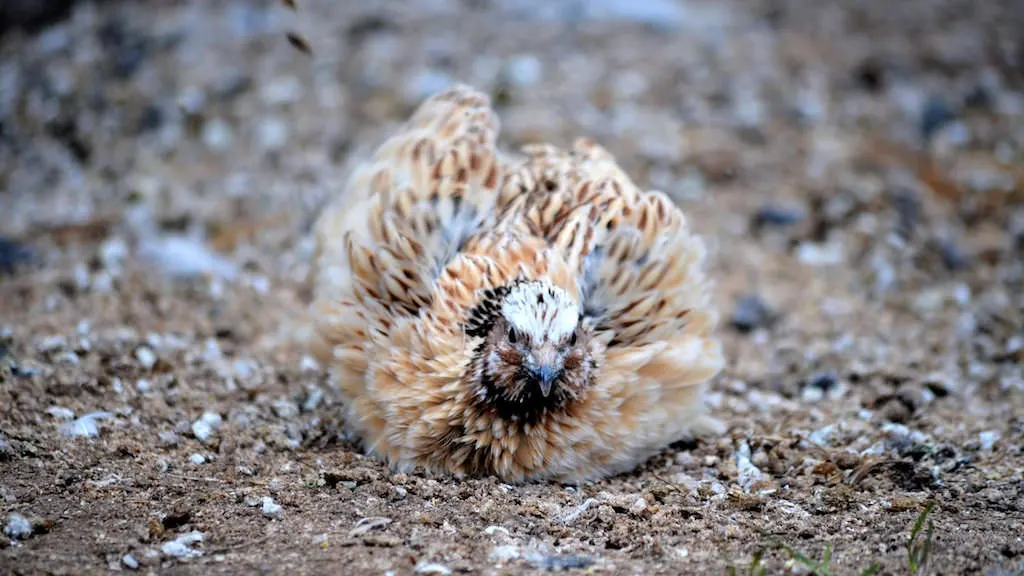
The first time I ran a pen of six roos and six hens, I thought I was being fair. Equal numbers, equal opportunity. Within four days I had two bald hens, a rooster with a torn comb, and eggs that mostly turned out to be duds when I candled them. That pen taught me more about the quail male to female ratio than any article I’d read up to that point.
Coturnix don’t pair off like some other birds do. One male will try to cover every hen in the pen, over and over, all day. Get the ratio wrong in either direction and you’ll see it fast, either in torn-up hens or in a hatch tray full of clears.
What’s the right quail male to female ratio?
For Coturnix, the number most working keepers land on is 1 male to 4 hens, with a workable range of 1 to 3 hens on the tight end and 1 to 6 on the loose end. Inside that range you’re trading fertility for hen condition. Tighter ratios post better fertility numbers in controlled trials, but in a real backyard pen, a rooster with only two or three hens will wear them out fast. Looser ratios are easier on the hens but past 1 to 6 you start losing eggs to a male who simply can’t get around to everyone often enough.
Other quail species don’t follow the same math, so don’t borrow a ratio from a Bobwhite forum post and apply it to Coturnix.
| Species | Males | Females | Notes |
|---|---|---|---|
| Coturnix | 1 | 3 to 6 | 1 to 4 is the most common working ratio |
| Bobwhite | 1 | 1 | Naturally pair-bonding, breed as couples |
| Button quail | 1 | 1 to 2 | Also pair-oriented, small groups only |
| California quail | 1 | 2 to 3 | Less domesticated, watch for stress in captivity |
I keep coming back to 1 to 4 as my default. It’s tight enough that fertility stays north of 80 percent in my trays, and loose enough that my hens still have feathers on their backs by week three.
What happens when you run too many hens per male
You won’t see this one in the pen. You’ll see it in the incubator. A rooster with 8 or 10 hens simply can’t cover every bird often enough, so some hens lay consistently fertile eggs and others lay duds, and there’s no way to tell which is which just by looking at the carton. Your fertility rate on paper might read 55 percent one week and 75 percent the next, with nothing about your setup actually changing. That’s the ratio talking, not bad luck.
What happens when you run too many males
This is the one that shows up on the birds. Too few hens for the number of roos in a pen and you’ll see feather loss on the back of the head and neck first, then bare patches between the wings, then raw skin where feathers used to be. One hen usually takes the brunt of it while the others learn to dodge. Multiple males housed together with access to hens is worse: they’ll fight each other for position, and quail fights draw blood fast because of how sharp their spurs and beaks are.
How many hens do you actually need?
Work backward from how many roosters you’re willing to feed and house. At 1 to 4, a pen of 4 hens needs exactly 1 male. Scale that up: 12 hens need 3 males, 20 hens need 5. If you’re still deciding on flock size in the first place, our guide on how many quail to start with walks through the numbers for a first-year setup, and this ratio should factor into that math before you order chicks.
Space matters as much as headcount. A crowded pen turns a fine ratio into a bad one because the rooster can’t spread his attention out and the hens can’t get away from him. Plan for at least 1 square foot per bird in a wire cage, and check our cage size guide before you commit to a specific box. A 24 by 24 inch cage comfortably runs one trio-plus setup: 1 male and 4 hens.
Feed matters too. Breeders need more protein than a bird you’re just keeping for eggs to eat, in the 20 to 28 percent range depending on how hard you’re pushing fertility, plus calcium and vitamin A and E. If your ratio is right and hatch rates are still soft, check what’s actually going into the feeder before you blame the roos. Our feed guide by age covers what breeders need on top of a standard layer ration, and Mississippi State Extension’s quail feeding programs is a solid reference if you want the university-level breakdown.
Do all-female or all-male flocks need a ratio at all
No, and this trips up a lot of new keepers. If you’re raising quail strictly for eggs and don’t care about hatching, you don’t need a single male. Hens lay just fine without one, the eggs just won’t be fertile, which is exactly what you want if you’re eating them or selling them for the table. An all-female flock has zero ratio math to worry about.
The flip side works too. If you’re raising quail for meat, you can run an all-male grow-out pen or a mixed group with no breeding intent, and the ratio question disappears entirely because nobody’s trying to mate anybody. The fighting and feather-loss problems only show up when males have access to hens they’re trying to breed.
Can you separate extra males instead of culling them
Yes, and it’s usually the first move before anyone reaches for the processing knife. Roosters kept together with zero females around can coexist in a bachelor pen without the territorial fights you’d see if hens were in the mix. I’ve run four extra males in a spare cage for months with nothing worse than the occasional crowing match at dawn.
Check Current Price
If you’d rather not add a cage, selling or rehoming extra roosters to another keeper works too. Most local quail groups on Facebook have someone looking for a rooster to freshen their bloodline.
The quick answers
The Coturnix quail male to female ratio that works for most backyard setups is 1 male to 4 hens.
The workable range runs from 1 to 3 on the tight end up to 1 to 6 on the loose end.
Tighter ratios like 1 to 2 or 1 to 3 post higher fertility in controlled breeding trials but wear hens down faster in daily keeping.
Feather loss on a hen’s neck and back is the first sign your ratio is too tight for your setup.
Inconsistent fertility with no visible injuries usually means your ratio is too loose.
Bobwhite and button quail breed as pairs, not harems, so a Coturnix ratio doesn’t apply to them.
All-female flocks kept for table eggs need no males and no ratio at all.
Extra roosters can live together in a bachelor pen with no females present and skip the fighting entirely.
Getting the number right isn’t about hitting some perfect ratio on paper. It’s about watching your hens’ feathers and your hatch tray and adjusting from there. Start at 1 male to 4 hens, give it two weeks, and let your birds tell you if they need more room to spread that attention around.