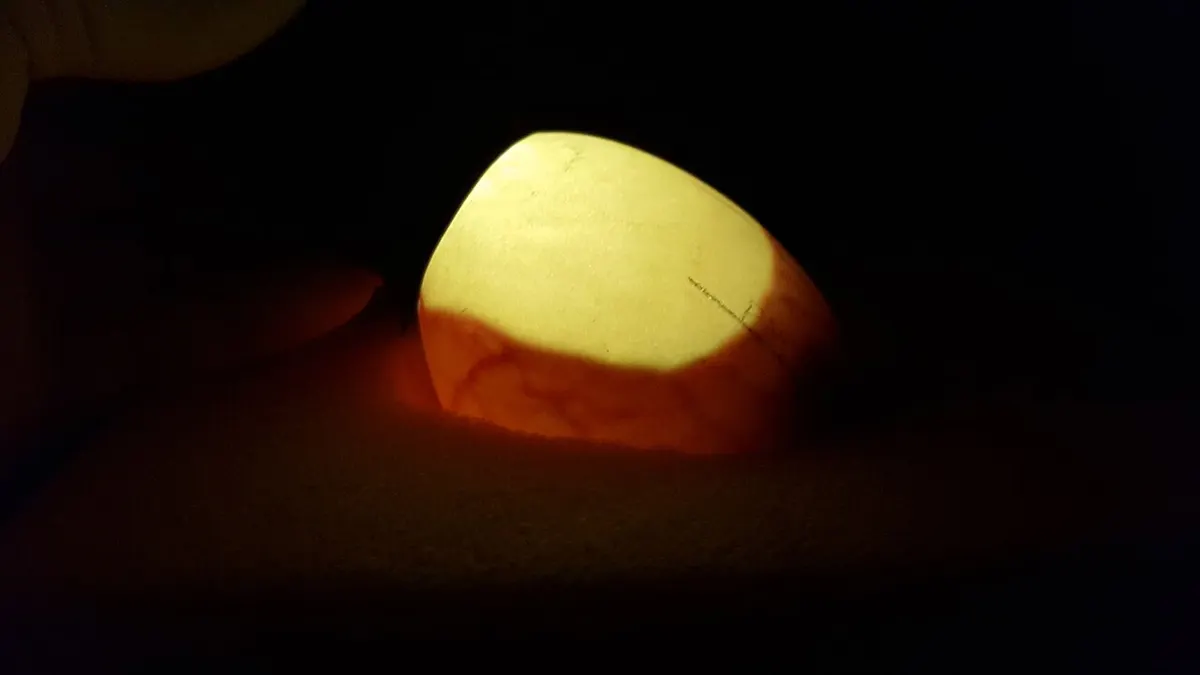
Candling quail eggs is the only way to know what’s actually happening under that shell before day 18 rolls around and you’re staring at eggs that were never going to hatch. I candle every batch I set, twice, no more, because quail eggs are small, dark, and speckled enough that people either give up on candling entirely or shine a light on them every single day and do more harm than good.
Here’s exactly when to candle, what a fertile egg looks like versus a dud, and the gear that actually works on eggs this small.
What Candling Actually Tells You
Candling means holding a bright light against the shell in a dark room so you can see the shadow of whatever’s growing inside. On a quail egg you’re looking for three things: a network of blood vessels branching out from a dark central spot (that’s a developing embryo), a clear or evenly lit interior with no shadow at all (infertile, sometimes called a “clear”), or a solid dark ring around the inside of the shell with no vein pattern (a blood ring, which means the embryo started and died early).
Quail eggs are harder to candle than chicken eggs. The shells are thicker relative to egg size and the speckling can hide early development, so don’t panic if day 5 looks murkier than you expected on a hen egg. Give it another day or two before you call anything.
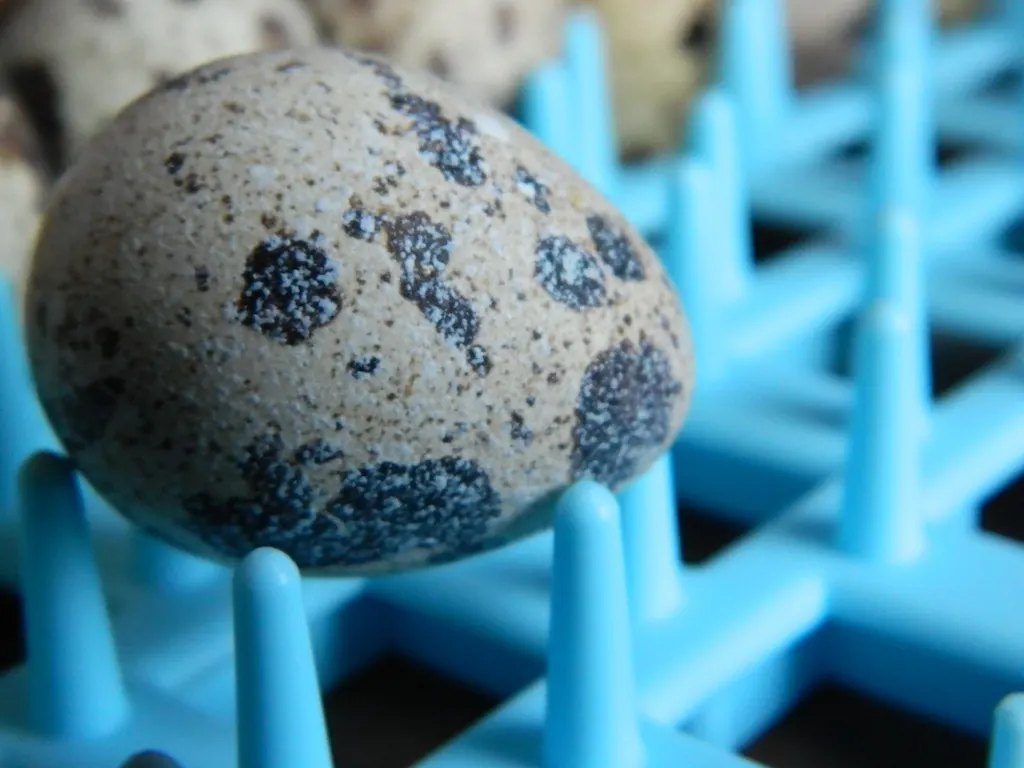
What You Need to Candle Quail Eggs
A phone flashlight works for chicken eggs. It mostly does not work for quail eggs, the light isn’t concentrated enough to punch through a shell this small and dark. A dedicated candler with a tight, bright LED beam makes a real difference.
 Rite Farm Products Quail Egg Candler. This is the one I actually reach for. It's a small cordless handheld candler built around 9 ultra-bright LEDs, sized and shaped to seal light against a quail egg instead of scattering it around the shell like a flashlight does. Runs on 3 AAA batteries, no charging cable to lose in a brooder box.
 Magicfly Rechargeable Egg Candler. If you also hatch chicken or duck eggs and want one candler for everything, this one ships with two rubber candler covers so the light seals against egg sizes from quail up to duck. It's rechargeable, about 3 hours on the charger buys you 6 hours of continuous use, which is more than enough for one candling session on a full tray.
| Candler | Best for | Power |
|---|---|---|
| Rite Farm Products Quail Egg Candler | Dedicated quail keepers, tight beam sized for small eggs | 3 AAA batteries |
| Magicfly Rechargeable Egg Candler | Mixed flocks (quail, chicken, duck), no batteries to buy | Rechargeable, 3 hr charge / 6 hr use |
Candling Quail Eggs Day by Day
I set my incubator at 99.5°F with roughly 45% humidity for the full 18-day incubation run, and I candle on exactly two days: day 9 and day 15. Here’s what’s happening on the calendar and what you’d see if you looked every day, even though you shouldn’t.
| Day | What’s developing | What you’d see if you candled |
|---|---|---|
| 0 | Egg goes in, nothing yet | Solid, evenly lit shell, no shadow |
| 5-7 | Blood vessels start forming | A small dark spot with faint veins branching out, easy to miss on a heavily speckled shell |
| 9 (candle) | Embryo visibly growing | A dense web of blood vessels around a dark mass that moves slightly when you tilt the egg |
| 14 | Embryo fills most of the egg | Mostly dark with a visible air cell at the fat end, hard to see individual veins anymore |
| 15 (candle, last check) | Final check before lockdown | Air cell has grown noticeably, egg is mostly dark with movement at the air cell boundary |
| 15-18 | Lockdown, stop opening the incubator | Not candled, humidity goes up to 65-75% and eggs stop being turned |
Don’t candle on a schedule tighter than that. Every time you pull eggs out to check them, the temperature drops and the humidity swings, and quail embryos are small enough that repeated stress actually lowers your hatch rate. Candle twice: once around day 9 to pull clears and blood rings, once around day 15 to see who’s still alive going into lockdown.
What Fertile, Infertile, and Dead-in-Shell Actually Look Like
Fertile and developing: a dark central mass with blood vessels spreading outward like the legs of a spider. By day 9 this should be obvious even on a dark quail shell. The mass moves slightly if you rock the egg gently.
Infertile (a “clear”): the egg stays evenly lit all the way through, no shadow, no veins, nothing. These were never going to hatch. Pull them so they’re not taking up incubator space and, more importantly, so they don’t rot and potentially crack near eggs that are still developing.
Dead-in-shell (a “blood ring”): a solid dark ring visible around the inside of the shell with no branching vein pattern past it. This means an embryo started but died in the first several days. It’s disappointing but normal, some percentage of any batch won’t make it, and pulling these early keeps them from going bad next to viable eggs.
If you’re not sure what you’re looking at on day 9, wait until day 15 rather than guessing. A slow-developing but viable egg can look ambiguous early and be obviously alive a week later.
How Many Times Should You Candle Quail Eggs?
Twice, total. Once around day 9, once around day 15, right before lockdown. That’s the answer I give anyone asking whether they should candle more often to “keep an eye on things.” You can’t fix a struggling embryo by watching it more, and every extra minute the eggs spend out of the incubator is a minute they’re losing heat and humidity. If you’re running a cabinet incubator with a built-in candling light, that’s a little gentler on the eggs since you’re not physically removing them, but the same two-check schedule still applies.
The Quick Answers
- Coturnix quail eggs incubate for 17 to 18 days total.
- Candle quail eggs twice: around day 9 and around day 15, not every day.
- A fertile egg shows a dark mass with branching blood vessels by day 9.
- A clear (infertile) egg stays evenly lit with no shadow the whole way through.
- A blood ring is a solid dark ring with no veins, meaning the embryo died early.
- Lockdown starts around day 15: stop turning eggs, raise humidity to 65-75%, stop opening the incubator.
- A dedicated candler with a concentrated LED beam works better on quail eggs than a phone flashlight because of the thicker shell and dark speckling.
According to Illinois Extension, candling should be done in a darkened room with the egg held close to the light source so the beam passes through the shell rather than around it, which matters even more on a small, dark quail egg than on a chicken egg. Mississippi State University Extension also notes that candling too early, before day 5 or so, mostly just wastes your time since there’s not enough development yet to see clearly.
If you’re still deciding on an incubator before your first hatch, I’ve got a full rundown of the incubators I’ve actually used, plus a budget-friendly roundup under $100 if you’re not ready to spend big on your first batch.
Candling quail eggs isn’t complicated once you’ve done it a couple of times, it’s just fussy the first time because the eggs are small and the window to see clearly is short. Two checks, a decent light, and a dark room is really all it takes.