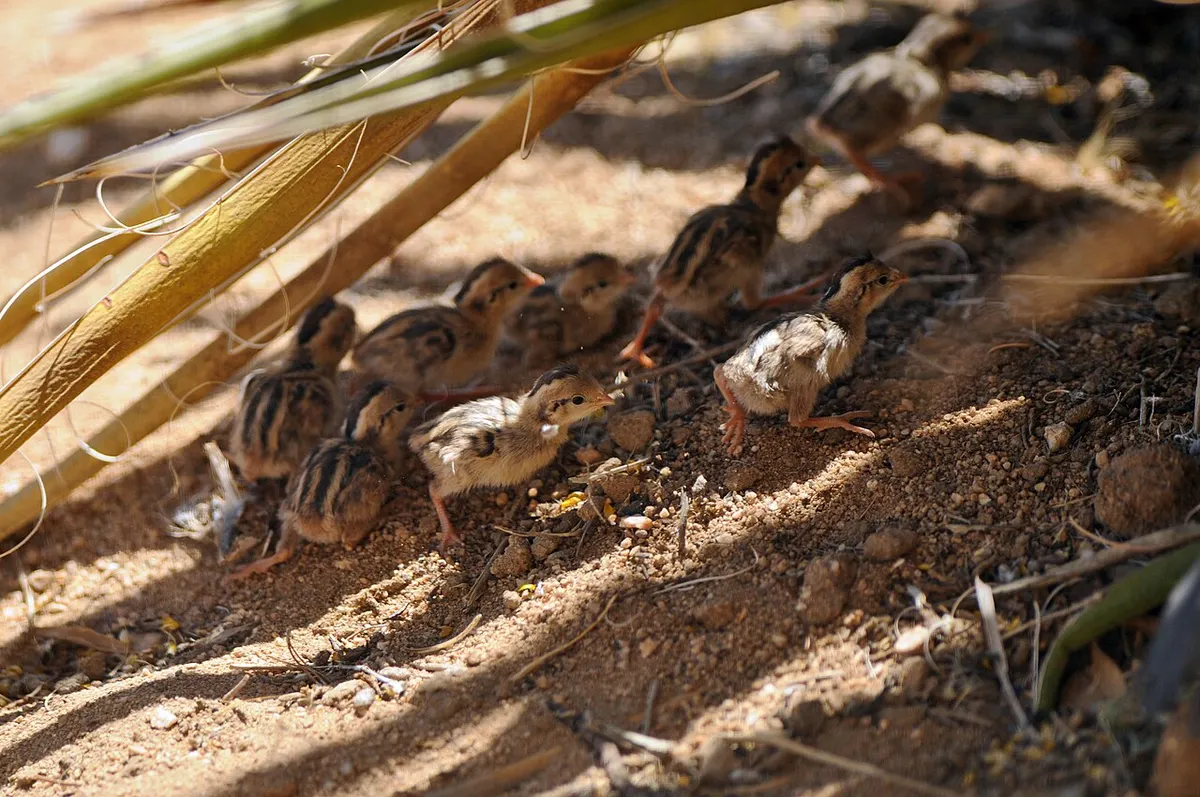
I asked around in quail circles what people wish they’d known before they started, and one thread kept surfacing the same handful of problems over and over. Not the stuff in the hatchery brochures. The stuff that actually trips people up in week two: a male that won’t stop screaming at 5 a.m., a hen with crusted balls of poop stuck to her toes, a bird that flushed straight up and broke its neck on a cage lid.
None of it is a reason to skip quail. I still think they’re the best “starter livestock” going, faster to results than chickens and quieter on the whole flock budget. But every one of these is predictable, and every one of these is avoidable if you know it’s coming. Here are the nine things that catch new keepers off guard, with the fix for each.
1. They explode straight up when startled, and that can kill them
Quail don’t run from danger, they flush. Straight up, as hard as they can, with zero warning. In the wild that’s a great way to dodge a fox. In a cage with a hard lid, it’s how birds break their necks or “scalp” themselves, hitting the roof hard enough to tear skin off the top of the head.
The fix is cage height, and there’s no safe middle ground. Go low, 12 to 14 inches of headroom, so a flushing bird can’t build up speed before it hits the top. Or go tall, 6 feet or more with a soft mesh or netted ceiling, so the bird loses momentum before contact. The danger zone is everything in between, roughly 30 to 50 inches, where a bird gets just enough room to accelerate and just enough ceiling to still slam into it hard. Keepers call it the kill zone for a reason.
Covering a tall pen’s ceiling with soft plastic mesh or a layer of foam turns a flush from a bang into a thud. It’s a cheap fix for a bird you can’t train out of the reflex. See our cage size guide for exact dimensions by bird count.
2. Males are loud, and they don’t warm up to it gradually
A male coturnix doesn’t ease into crowing. He goes from silent to a sharp, repeated “cock-a-wheet” the first morning he feels confident, often before 6 a.m., and he’ll keep it up through the day whenever he feels like announcing something. If you’re in an apartment, a townhouse, or anywhere with a shared wall, one male can undo your whole plan to keep this quiet.
Hens, by contrast, are genuinely quiet. A soft purring chatter, maybe a quiet “buk” when they lay. If noise is a real constraint, an all-hen flock solves the problem outright, you just won’t get fertile eggs without a male somewhere in the mix. Our guide to raising quail in the city covers this in more detail, including how to place a cage to muffle what sound there is.
3. They need more protein than chicken feed provides
This is the single most common feed mistake, and it’s an easy one to make because quail feed can be hard to find locally, so people grab what’s on the shelf. Chicken layer feed runs around 16% protein. Quail need considerably more at every life stage: chicks want a 26 to 30% gamebird starter, growers do fine on 20 to 24%, and laying hens need 20 to 24% with the calcium bumped up for shell production. Birds you’re actively breeding benefit from the higher end of that range, closer to 24 to 26%.
Feed them chicken crumble long-term and you’ll see it in thin, cracked, or slow-to-appear eggs, and in hens that burn through body condition fast. If your local feed store doesn’t carry gamebird starter, a flock raiser or turkey starter at the right protein percentage is a reasonable stand-in until you can order the real thing. Michigan State University Extension’s guide to Japanese quail has backed up these protein ranges for decades, if you want the source rather than my word for it: MSU Extension, Japanese Quail (Coturnix).
4. Chicks can drown in water barely half an inch deep
Day-old quail chicks weigh about as much as two dimes, 6 to 8 grams, and they have almost no coordination the first few days. A standard chick waterer that’s perfectly safe for a baby chicken can be a drowning hazard for a quail chick, because the water only needs to be a little over half an inch deep to be dangerous.
Drop clean marbles or washed gravel into the base of the waterer for the first week or so. It fills enough volume that a chick can’t fully submerge, and chicks will peck at the shiny marbles, which actually helps them find the water source faster. Dip each chick’s beak in the water when you first move it to the brooder, since quail chicks don’t always figure out where the water is on their own, and a chick that doesn’t drink in the first day or two can dehydrate fast. A stable heat source matters just as much here:
 RentACoop 12x12" Adjustable Heating Plate. A radiant plate the chicks walk under instead of a heat lamp overhead, which cuts fire risk and gives chicks a hiding spot that doesn't scorch feathers if they sit too close.
Full setup details are in our brooder setup guide.
5. Poop builds up fast, and droppings trays aren’t optional
Nobody warns you how much a small bird can produce. Quail are efficient, high-output eaters, and what goes in comes out in volume, concentrated enough that ammonia smell shows up within days if you’re not managing it. A cage with no droppings tray, sitting directly over bedding or ground, gets rank fast and stays that way.
A pull-out tray lined with something absorbent, pine shavings, sand, or a shavings-and-straw mix, and emptied every few days solves most of it. Composting the droppings instead of trashing them is worth doing too, quail manure is “hot” (high nitrogen) and needs to age before it goes near plants, but it makes genuinely good finished compost. See our bedding comparison for what holds up best against odor and moisture.
6. Standard chicken wire won’t keep predators out
Chicken wire stops a chicken from wandering off. It does essentially nothing against a determined raccoon, which can reach through the gaps and pull a bird apart without ever getting inside the cage, or a weasel, which can fit through openings most people wouldn’t believe.
Use half-inch hardware cloth as your baseline on every side of the enclosure, including the floor if it’s a ground pen, since rats and snakes dig. If you’re in an area with weasels, mink, or persistent snake pressure, drop to quarter-inch hardware cloth for at least the bottom 12 to 24 inches of the perimeter, where the smallest predators try to get in. It costs more and traps a bit more dust, but it closes the gap the half-inch mesh leaves open. Bury or apron the edges outward so nothing can dig straight down along the wall. New Hampshire Fish and Game has a solid rundown of the same principle for backyard poultry generally: predator-proofing backyard flocks.
7. Poop can ball up on their feet and cause real damage if ignored
Especially with chicks on damp or dirty bedding, droppings can cake onto toes and harden into what keepers sometimes call “maltesers,” hard balls stuck fast to the foot. Left alone they’re not just gross, the ammonia in the droppings can irritate the skin underneath, and a hard enough ball can set a young, still-flexible toe in the wrong position as the bird grows.
Never pull one off dry. Stand the bird in about an inch of warm water for a few minutes, the ball softens, and it usually slides or gently squeezes off without any resistance. If it doesn’t come free easily, soak longer rather than forcing it. Check feet when the bedding has been wet or soiled for more than a day or two, since that’s almost always when this starts.
8. Not every death has an obvious cause, and that’s normal with this bird
Coturnix are genuinely fragile in ways chickens aren’t. A startled bird can flush and break its neck on a lid. A panicked bird in a crowded cage can trample a cagemate. Heat stress hits them faster than it hits chickens. And sometimes a bird that looked fine the night before is just gone in the morning, with no visible wound and no warning sign you could have caught.
That’s not always a management failure. It’s part of keeping a high-strung, fast-living bird. What you can control: keep stocking density reasonable, keep the cage calm and predictable (same entry point, same routine, no sudden reaches), keep protein and calcium where they should be, and watch for repeat losses in the same cage, which points to something fixable rather than bad luck. If you’re losing birds regularly and can’t explain why, that’s worth a call to an avian vet or your state poultry diagnostic lab rather than guessing.
9. Males fight, and overcrowding or a bad ratio makes it worse
Male coturnix compete, and in a cage that’s too small or too male-heavy, that competition turns into real injury: scalped heads, torn feathers, hens pinned down and over-mated until their backs are bare. This is one of the most common reasons new keepers end up rehoming or culling birds they didn’t expect to.
The ratio that works for most backyard setups is one male to four or five females. Tighter than that and competition between males spikes; looser than that (more hens, fewer or no males) and the flock runs calmer with no real downside unless you need fertile eggs. If you already have more males than that, separate them before you see blood, not after. Our male-to-female ratio guide walks through sizing a flock from scratch.
The short version
- Quail flush straight up when startled, so cage ceilings need to be either 12 to 14 inches (low) or 6-plus feet with soft mesh (high), never the 30 to 50 inch range in between.
- Males crow loudly and unpredictably from their first confident morning; hens stay quiet, so an all-hen flock is the fix for noise-sensitive settings.
- Quail need 20 to 30% protein depending on age, well above the roughly 16% in standard chicken layer feed.
- Chicks can drown in half an inch of water; marbles or gravel in the waterer base prevent it for the first week.
- A droppings tray with absorbent bedding, emptied every few days, prevents the ammonia smell that builds up fast without one.
- Half-inch hardware cloth is the baseline predator barrier; drop to quarter-inch at the base of the enclosure where weasels or snakes are a known problem.
- Poop balls on feet should be soaked off in warm water, never pulled off dry.
- Not every sudden death has a clear cause; repeated losses in one cage point to a fixable problem, isolated ones may not.
- A 1-male-to-4-or-5-female ratio keeps competition and over-mating in check; separate extra males before injuries start.
Nothing here should scare you off. Every keeper who’s been at this more than a season has hit at least three of these the hard way. Know them going in and you skip the expensive lessons entirely. For a realistic sense of the day-to-day, see a day in the life with my birds.